Thursday, July 15, 2010

Isn't this starting to feel a bit like July 2009?

0 comments

Team Macro Man fully expected after a 6 day, 9% rally that equities are due a correction, yet despite the best efforts of Mayfair and Greenwich, seemed supported on dips, only managing to put in a Doji despite the FOMC mentioning the dreaded "D" word. With the Aussie pushing the highs post-China reval level, TMM has been forced to admit that actually, whilst equities & bond yields made new lows (was it really just a week ago...?), neither the metals space (especially Copper) or risky FX markets did. This is despite the fact that at least 90% of TMM's emails and IBs seem to, even now, still be resolutely bearish in their commentary, or attempting to suggest that punters are being sucked into buying at the highs. Now TMM is of the opinion that much of the past week (as mentioned in yesterday's post) has simply been position-reduction (either forced, or voluntary), but can't help be reminded of the last time markets that were fretting about a double-dip and got sucked into a bear-trap which was subsequently followed by a very aggressive multi-month rally. Team Macro Man remembers it well as they were amongst those that were the wrong way around that time...


So what was the set-up in July 2009?


  • A Head and Shoulders pattern had recently completed.

  • The S&P500 had broken below its 200day moving average.

  • Double-dip fears related to the inevitable multi-year de-leveraging of household balance sheets and scepticism about the existence of a recovery and credibility of the stress tests were widespread.

  • There was a large dichotomy between traders and analysts with respect to whether earnings and guidance would be good or not.

Sound familiar? As we now know, traders were wrong and analysts were right, with a blow-out earnings season powering equities higher with little correction, forcing players to chase. Although we have only had a handful of earnings releases, there have been some from important companies (Alcoa, Intel & Novartis) that have both beaten strongly as well as raising guidance, and this has forced many to cover their shorts. As TMM's wise friend RightField commented yesterday, before players will truly embrace such an analogue, they will need to see some of the earnings of the financials given the poor conditions in the housing market and political sensitivity with respect to the FinReg Bill (no point showing great earnings if it will spark more populism in the yet-to-be-passed Bill). But if earnings and guidance continue to print well then deflation/double-dip concerns are likely to dissipate.

Of course, TMM is not suggesting that the situation is exactly the same. ISM, for example, was rising and the inventory build was just beginning to get underway - this time, it is falling and inventories have already been built. But as at least some offset to that, equities are cheaper relative to earnings expectations now (at 13.5x current year earnings) than they were in July 2009 (16x current year earnings) and a falling ISM is not the same as a double-dips (something that is rarer than a dog that speaks Norwegian). And TMM wonders if rather than weakening, Payrolls have merely been coming into line with other measures of the labour market - the chart below shows private payrolls (orange line) vs. the GDP-weighted Employment components from the ISM and non-manufacturing ISM reports (white line). Private payrolls clearly outperformed the survey measures for a while and have now come back into line with them. And even the most entrenched bears would struggle to argue that that chart does not look like a "V" - it is just that the fall was so sharp and over a larger period of time than in prior recessions, and thus so must be the recovery.


But enough cheerleading. The above analogue is dependent upon financial earnings, so today's numbers from JPM are important in that respect, if they disappoint then TMM expect a Soothsayer turn for the worse on Monday. Indeed, TMM are sympathetic to the view that should core-CPI surprise the downside tomorrow that deflationary fears will reach a new height. As mentioned yesterday, TMM has a long-held theory about market turns around the 16th/18th July, but wonders if we might have already seen it? Isn't it starting to feel a bit like July 2009...?

Wednesday, July 14, 2010

Was that a sign of life? Or just a death twitch...?

0 comments

Yesterday looked as though the markets were making a break for it - the wrong way at that. But did anyone actually put ON any high conviction trades? It felt as though the preponderance of trades were exits of positions with a combination of pleasure and pain. The relief of profits taken on trades that have been underwater, or the pain of stops being driven. Thank you Intel. CHF has been a class example, with SNB LLC posting some sizable book profits overnight (well, lower losses). Is Mr. Market trying to tell us something?

But this spiky squeeze doesn't run against the rangy summer theory. In fact, at this point it can reinforce the argument. A nice top range squeeze flattening core positions further followed by a roll over would be another red hot poker to the nether regions. Looking at Mr Soothsayer's charts, they have been working remarkably well recently in the likes of FTSE and suggest a roll-over weekend is ahead. Which ties in nicely with a pet theory that the weekend of 16th-18th July-ish produces a general turn in equities. OK, it’s a bit of an old theory emanating about 12 years ago but it still lurks in the back of TMM's mind.

It also looks as though the gags are holding with Europe's STFU policy and it may be a wait until September for the Spanish 2011 budget vote time bomb to blow a hole below the waterline. And if there is a season for crises it's Sep/Oct.

But back to Intel. A long-held view of Team Macro Man is that the demand baton would have to be passed to corporates given the consumer deleveraging, the limited ability of governments to enact fiscal stimulus and a general skeptical view of the extent to which China & the rest of the BRICs can get us out of this mess. We are taught that the government's financial deficit is the flip side of the private sector and external sectors' financial surpluses. And today is no different, governments are running very large deficits, whilst China et al. are stubbornly running surpluses, as is the private sector. But the private sector contains both households and corporates. The former, we know, needs to gradually delever and rebuild its balance sheet, but the latter has pretty much been repairing them for the past decade since the DotCom bubble burst, running very large financial surpluses and, as recent press reports attest, holding the largest amount of liquid assets as a share of balance sheet since the early-1960s. The billion-dollar question is whether corporates will actually put this to use or not, and Team Macro Man will have a go at trying to determine this.

Now, TMM certainly does not want to get caught in the cross-fire of the cat-fights between Neil Ferguson and Paul Krugman, but it seems to us that there is quite a big difference between Corporate America today and the Zaibatsu of 1990s Japan (who were just beginning their deleveraging). As the below chart shows, corporate investment growth in that period just went sideways, with the odd cyclical recovery snuffed out by either poor policy decisions (1997's consumption tax) or external factors (2000's DotCom burst).The below chart shows the equivalent US numbers over the past 30yrs. What is especially interesting to TMM is just how weak business investment following the DotCom burst, growing at an essentially flat rate of 0.25% YoY over the business cycle. In contrast, during the 1982-1991 cycle it averaged 3.66% YoY and during the 1991-2002 cycle averaged 5.55%.

A very wise hedge fund manager once said to TMM with respect to the punters' favourite, the Yen, that "if you want to know when it will weaken, you first have to find out why it has been strong". Wise words, indeed, and they certainly apply here - why was corporate investment so weak over the last cycle? TMM believe this is simply the side-effect of the massive over-investment of the 1990s when businesses expanded aggressively into IT-related projects, and then were forced to write these off and rebuild their balance sheets. A desire not to be caught out again by liquidity factors (exacerbated by the 2008-9 experience) has also led them to keep more cash on balance sheet. But we note that much of the infrastructure investment of the late-90s is now, largely, out of date. Which is why they were especially interested to read the following headlines:

*INTEL SAW RESURGENCE IN ENTERPRISE MARKET FOR PCS, SERVES
*INTEL SAID IT BENEFITTED FROM RESURGENCE IN COMPANY SPENDING

Now, one swallow does not make a summer, but if this trend continues it would be very positive. The trouble is that the signs elsewhere are not so promising. The Philadephia Fed survey's 6m-Ahead Capital Expenditure expectations component (chart below, white line) is pointing to a double-dip in capital formation (brown line, lagged 3m). Worrying, but Team Macro Man also notes that the survey double-dipped in mid-1993, but actual investment (and the economy) continued to improve... The evidence is thus mixed and the answer unclear, and Team Macro Man would like to invite readers to present their own views on the subject.A corollary to this is that should USD & USDAsia weakening send jobs back to America, a reversing of the general "out-sourcing" of the past decade or more would give a further driving force to a recovery in corporate capex. Compare the collapse in US capex to the supercharged Fixed Asset Investment in China over the same period:

However, for now, the stalemate between bulls and bears may continue. But in reality there are no Bulls and there are no Bears: only Sheep. And 'tis better to be the Shepherd than the Sheep.

Tuesday, July 13, 2010

I can sit here as long as it takes...

0 comments

Sorry, we fell unconscious for a couple of days. We caught it off the markets.

Dull this isn't it? There we were looking for the Euro negatives to come back into focus and whilst the euro has indeed stopped going up, someone instead appears to have tripped over the power lead to the markets. A bear market doesn’t end like this does it? How does a bear market end? Well, in the "long only" days there was normally no one left to find out. But that has changed with many punters eagerly enjoying down legs as much as up legs. So the asymmetry of desire and expectation has changed dramatically thanks to spread betting and futures trading opening up to the masses. TMM is reminded of reading trading books earlier in their careers that instruct traders to look at volumes to confirm prices, and often comes across comments like "there isn't any volume or breadth in this rally/sell-off", which seems to TMM a bit like an excuse not to cover if you are short or not to sell if you are long. Perhaps this is another feature of "modern" bear markets. You only have to look at CNBC who now seem to be happy to wheel out streams of bears calling doom and gloom, while 10 years ago it would have been corporate suicide to even mention an equity negative. The best they could get away with was a "well it's dipped but this is GREAT news for us permabulls as we can buy it cheaper". Hang on... Where have we heard that recently. Err, oh yes, the GGUF crowd. You might as well prepare yourself to be buried up to the chest and stoned to death as mention that Gold may go down. In fact there is a frightening correlation in the comments column between the G word and emotional if not religious content. So that’s enough about Gold (with a silent L for many).


But anyway, you can't really say that a bear market ends these days in silence. A whole market itself can end in silence like a burnt out star in the depths of space, but this market still has too many folks jumping up and down on the sidelines cheering on their favorite trades. Its just a shame that they all appear to have stopped for a relax in the sun. Even BP shares have relaxed (I wont say “popped down to the beach”) , poking up to 400p again = 35% rally blah blah. Don’t be fooled by percentages.


But the massive dichotomy in outlook remains. In equities its either massively down, or massively up with very, very few folks happy to say "You know what? Despite all the recent fun and games, we go nowhere this summer". But as the "path of pain" is the way Mr Market likes it and if sitting quietly saying nothing has the same terrifying effect as the knotted ropes and electrodes, then so be it. Remember the school-class terrors of the teacher's "I can sit here as long as it takes ….". Well, it's already starting to hurt...

In times of low vol the carry army tend to come out of the woodwork and no doubt carry creep will drift in again. The other trend is that instead of looking at the main current of global trend, with zip-all happening at this slack tide, folks start to explore the eddies around the edges for some movement. And so it may be with peripheral markets and pairs that have been swamped for the past few months by the general "risk on, risk off" correlated movement in G10. So which periphery shall we have a look at? How about our dear friends the Scandies again. Do you know the Scandies ? Lovely couple. And they've been doing rather well.

Norwegian GDP (yellow line), Swedish GDP (orange line) and Eurozone GDP (white line):


Swedish Industrial Production (white line), Norwegian (orange), German (yellow), French (green) and Italian pink):
And when we look at today's critical test of fiscal discipline they are in the "Miss Whiplash" camp, which Mr Gross prefers to call his "Axis of Good". Nice (remind us to write a post entitled “Miss Whiplash and the Axis of good” one day). Sweden, for example, is projecting a nearly balanced budget for 2010, a feat at which many other Western sovereigns can only marvel. Far, far from the Nitro-glycerine, Fire and Brimstone budgets of more southern latitudes. Mr Gross has even provided us with his "ring-piece of fire" chart, we think that's what he called it:


So if we consider the PIGS at Vindaloo strength (sorry, but we don't know what that is in Scovilles and we look to our American readers for a curry/chilli conversion matrix) then we can see that Scandinavia is but a mere Korma with extra yoghurt by comparison. What is more, both the Riksbank and the Norges Bank have recently surprised the markets with relatively dovish statements, while delivering the widely expected rate hikes. The full set menu indeed, with the bhajis and nans thrown in. The only concern is how long ago was that Norway data cooked as it may be on the turn. But we should be well out of the restaurant by the time that causes any grief.

And if Scandies are the buy in a drifting market what is a reasonable sell? Well, when the market gets frustrated with everything else and looks to load up on some short risk, the NZD is a usual boredom target. And if we look at NZD, as the world tends to through AUD/NZD (chart below, white line), we can see it tends to behave inversely to global volatility as measured through the VIX (yellow line):The market has been pretty washed out of its last lot of NZD bashing positions and so the longer we sit here the more folks may drift into that boredom driven NZD-selling trade.


So whilst Mr Market leans back in his chair, the summer evening sun streaming through the windows, our friends with proper jobs wandering off home or on holiday. We are thinking of killing some time by tucking into the NZD/NOK Lamb korma cross.

Wednesday, July 7, 2010

Eurostriches

0 comments
Back in mid-May we were concerned that the Europarity Knights were getting a little over-excited and that the pathetic little bunny of the Euro, up for the slaughter, may put up more of a fight. And indeed since then the harmless Euro Bunny has beheaded a number EUR/USD short knights and it feels as though many more have run away. Both in FX and also in periphery spreads.


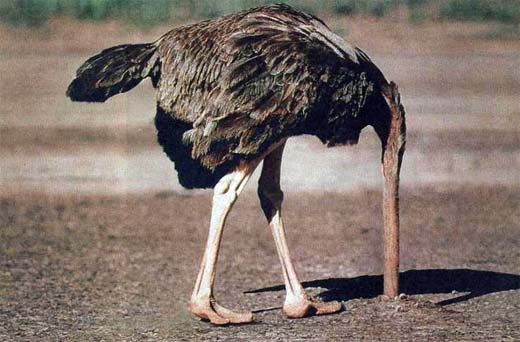
What is remarkable though, is the European Policy that has resulted in such a turn around, appears to be little more than the Timmy G's inspired "Shut the Fuck Up". And believe it or not, it is actually working. What is more remarkable still is that they have been able to keep it up for so long. This Bunny is more like an ostrich. It’s as though this policy of burying your head in the sand has resulted not only with the Eurostriches ignoring where they are, but also with the market predators on their tails suddenly losing sight of them too, responding with a "Huh, where did they go? " and charging off chasing a weak US and limping China instead.

But how long can Europe hold its breath for? With a market much more balanced now in its perceptions of relative risks between US, the East and Europe, the Eurostriches may feel it safe to surface again. And if they do they may well find a confused market willing to take up the chase again having lightened their previous positions. So lets have a look and see if there is anything to tweak the nostrils of the predators...

First off, we have the bank stress tests which appear to involve seeing if they can take the stress of a feather laid gently across their backs and have as much validity in the real world as the UK educational qualifications. Or maybe they do turn out to be credible, but with far worse results than anyone was expecting. Team Macro Man cannot imagine the market taking headlines like " to take EUR30bn writedown on sovereign debt holdings, will receive capital injection from Soffin" or "S&P downgrades Deutche Bank to A-" particularly well.

Second, Thursday's ECB press conference has the potential to throw a tape bomb - Monsieur Trichet has never been particularly good at communicating. With the press having whipped itself in something of a frenzy with respect to the ECB's LTRO/MRO, term deposit auctions and sovereign purchase plan, TMM would not be suprised if there were some misunderstanding that led the market to believe that either (i) the ECB is about to sell its EGBs, (ii) that it might be about to cut rates, or (iii) that it is about to embark on QE (because, of course, they're not *really* doing it are they...).

Third, while Europe's economic data has thus far held up (in sharp contrast to that of the US), this morning's weak German factory orders perhaps provides a hint of tomorrow's Industrial Production number. Team Macro Man wonders how long it might be before they see the Bloomberg headline "German Current Account posts deficit for the first time since 2003".

And it looks like the market is about to grab Spain by the Cajas...

Monday, July 5, 2010

Can we be in charge of sports please?

0 comments
In normal Macro Man tradition, we will use a public holiday to step back from markets and take a lighter-hearted look at the world. The last few weeks have seen a rash of sporting events dominate the world's interests and our own social diaries. As a meringue is just a vehicle for cream, many of these events are just a vehicle for grand socialising. Ascot apparently has horses racing, Wimbledon has some tennis matches and we gather that at Henley there is a river with boats racing on it. But these are mere sideshows compared to the real job of dressing up, eating too much and then drinking FAR too much in the sun with old friends, whilst basking in the timelessness of these bastions of tradition, forgetting the woes of the real world. Escapism indeed.

But whilst discussing the fortunes of English sport at one of the grand picnics at the Henley Royal Regatta last weekend, the conversation turned to what we should expect from our sporting heroes. Nowadays, they appear to have to fulfill many roles, no longer just having to be good at their sport. They also have to be good looking, entertaining, nice people, who reflect our own views on the world and behave in ways we respect. Unfortunately, most of the England football team fail those criteria on every count. Unless sleeping with most of your in-laws, or your team-mates' in-laws, fighting over it, being useless in your chosen sport and getting paid 120k a week for it is what you feel everyone should aspire to.

So why can't we strip out all the different functions we expect of a sportsman and not be allowed to judge them on anything apart from their ability to perform at said sport? Perhaps, if that was the case, even we may end up supporting Andy Murray? He has never been a favourite, but he lost all our respect over the debate of whether or not he would bow to the Queen, but, to be fair, once we heard that he had never suggested he wouldn't, we restored him back to the level of respect we had held him in before the incident. That of Grade "A" Tw@t.

And as for the sports themselves, there are some great events out there but most of them appear to have been neutered from their original forms by their overly-powerful governing bodies. For example, Formula 1 motor racing is now pretty tedious weekend afternoon TV. And downhill skiing is just background cowbell noise for post-hangover winter Sunday evenings. It's just not exciting to watch anymore. What happened to the verve and thrill-seeking of the pioneer days of motor sport, or the recklessness of the first English madmen who started racing down mountains on planks?

We suggest we shake things up and take them back to their roots. A clue to where we are coming from was obviously apparent in the enjoyment and excitement we all felt towards the best new sport at the winter Olympics. The Ski Cross. None of this "one at a time", timed tedious nonsense. Four or six competitors set off from the top and the first to the bottom was the winner. Just like the sort of race you'd arrange with your friends. Now, we know that the TV companies would not have as much material to fill the hours and the self-aggrandising sports officials wouldn't have as much to do to justify their existence, but we strongly feel that the men's and women's Downhill, Super G and Slalom should all run on the same basis. Each is just one race with everyone starting at the top together at the same time, and the first one down wins. The only rules being "first to the bottom wins" and "no weapons".

And the same for Formula One. Let's bring it back to its roots. You close a large stretch of motorway, say London to wherever "oop norf", line up all the cars and say "Go". You can have whatever car you fancy with the only rule being that you can only fill up at existing petrol/service stations using the regular pumps. We will let the drivers off from having to queue to pay as they may get distracted by the pig-nostril pies in the hot cabinet or stand there wondering if the extra 2 pounds for the under-body wax included in the 5* option car wash is really worth it. But you get the drift. A sort of legalised turbo-charged Gumball rally. THAT would be worth turning the TV on for.

And while we are at it, let's look at the Olympics. A good friend of ours has had a brilliant idea over how they should be reorganised. And it makes total sense. At the moment, we have an enormous bias towards countries with the largest populations as they have a greater sample size from which to pick their best performers. We also have the resulting TV coverage of a load of people doing what they chose and trained to do (Yaawn...). So instead, the selection process should change completely. From now on it will be done by BALLOT. A whole country's population is eligible aged between say, 16 and 60, and so 4 years before an Olympics, names will be drawn AT RANDOM to select who will represent their country for each discipline... Yes, think about that for a moment... You may well get a letter through your letter box saying "Dear Sir/Madam, We are pleased to inform you that you have been chosen to represent your country in the 100 metres hurdles at the 20xx Olympics".

This form of selection will get rid of the bias that high population countries have and gives a much fairer representation of a country's overall fitness and sporting ability. It would mean that each competitor would have 4 years to train in whichever field they have been randomly selected for and there would be no shirking or sick notes from your Mother. You would HAVE to attend. It would give communities such a boost and focus to suddenly realise that Mabel in the Cake Shop was going to have to do the synchronised diving, or Jim the taxi driver was going to be in the 100 metres. The TV companies wouldn't complain either. Four years of "following your local through the build up" programmes would result in top quality reality TV, NOT governed by Simon Cowell or that musical-writing man with his face on inside out. Brilliant.

And while we are at it, here's another idea associated with the Olympics, or in fact any sport, that would instantly solve the problems associated with drugs, stimulants and other such performance-enhancing practices. You don't ban them, you ALLOW THEM ALL. Yes, you can take what you like. It's your life and it really isn't up to us to tell you what you can't do to reach your dreams. And yes, we hear on reality shows all the times how much the contestants "really, really, really want it". Well there you go, your choice, and if you really, really want it enough to kill yourself then we are not stopping you. And the money coming in from pharmaceutical sponsorship could be huge... "In Lane one we have Ben Johnson sponsored by Novartis, in Lane two sponsored by Hoffman-LaRoche we have...".

This weekend saw another event kick off that could really benefit from an overhaul on the above lines. The Tour de France. It has always been plagued by drug controversy and has been broken into so many stupid sub-stages/sprints and jerseys etc. That from now on, we propose that all the cyclists start together in Paris and, simply, the first one to cycle around the country and get back to Paris is the winner. Easy...

So, can we be in charge of sports please?

Friday, July 2, 2010

Pleasure Before Work

0 comments
Team Macro Man are somewhat busy today and will be enjoying the delights of summer sporting events rather than waiting for the outcome of the NF lottery. But here are some brief TMM thoughts:

TMM is not sure what the whisper number is for private payrolls, but we would guess it is closer to +80k than the Bloomberg consensus of +110k. There does seem to be a consensus that people
are not really short risky assets, and yesterday's price action suggesting another round of short-covering would support this view. As suggested by the moves in US Financials & Gold yesterday, the remaining reflationists are still hurting, so bounces will be used as an opportunity to reduce risk by those participants.

Even entrenched bulls are struggling to argue with two months of disappointing US data. That said, however, USTs have struggled to hold on to their gains the past couple of days despite equities
extending and, peak-to-trough, since China announced its new FX policy, equities have fallen nearly 11% with little bounce. US holidays can often mark general market turns, and with the 38% Fibonacci retracement from the March lows to the April highs close by together with the psychological 1000 level all piling up ahead of earnings, the risk-reward is not obvious.

The divergence with Europe, however, only appears to be getting larger with financial stress having fallen significantly following increasing clarity with respect to the stress tests and the ECB's LTRO/MRO take-up (TMM found the level of attention on such esoteric details of the money market rather amusing), still-strong demand at sovereign auctions (Spain yesterday), a large tightening in
peripheral & semi-core bond markets over the past few days (see chart below), and reasonably strong European PMIs yesterday suggest that the crisis has not yet spilled over into European growth.Together, this suggests that should the number be strong, Equities will squeeze (yesterday's hammer will be an excuse), but EUR/USD has the potential to squeeze even more. However, if the number is bad, weakness will be led by those economies leveraged to the US - EUR/CAD & EUR/MXN look prime suspects - and the remaining assets that have yet to materially price in a disinflationary theme: Gold. Yesterday provided some hints of this as even Gold joined in the Euro squeeze-fest, and we are pretty sure that was Gold/Euro-driven, as it gapped through the rising trend of the last couple of months. USTs will lag, however, with breakevens moving at the expense of real rates.

Thursday, July 1, 2010

Due to Unforeseen Circumstances

0 comments
Right, folks, before we start, as an answer to the market mosquitoes constantly buzzing around with their high pitched whines of dark-battle-death-star-galacticas on the SPX charts, encouraging us to mortgage the kids to load the boat of shorts, we do recommend "Star-No-More" or " Death-Star-Off" - whose active component can be seen on this post on "The Big Picture". It would appear that the active ingredient in dark crosses is at best homeopathic.

Well, it's half time in the game of 2010 and it's probably time to sit down, suck half an orange, take a breather and a pep-talk/berating from the coach. So how are we doing against game plan? Well, so far it's the bookies who seem to be the winners, as favourites are dropping like flies this year. Yesterday Federer went out at Wimbledon to a shock defeat by little-known {inset little-known name here}. The day before Venus Williams went out to little-known {inset little-known name here}. The World Cup saw Italy and France out early to shock defeats by little-known {inset little-known names here}. The only pattern to have emerged in sportsland is that the {inset little-known name here} normally ends in "-ich" or "-ic" or is composed of a team load of "-iches". Has all that Swiss franc financing in Eastern Europe found its way into sports facilities?

In the world of finance the favourites have done just as poorly. There are few of last December's "trades du l'annee" still standing either. Back in Dec 2009 the 2010 game plans were being drawn up against a world of devaluing dollar due to its printing presses, recovering economies and the EU air fresheners were still shrouding the stink from the t&rd buckets of Europe and the double dippers were still hiding in their caves. But if you were to now score the top bank 2010 recommendations you were sent, we would have a friendly that the bookie has won again.

Remember such classics as short USD, long Chinese equities, short JGBs, short USTs, long CEE/JPY, in fact short JPY vs everything. All have been taken out by "Unforeseen Circumstances". Poor old BP have even lost 100000000000 - 0 to an "unforeseen circumstance". At this rate it seems like the Mayan predictions of 700 yrs ago are having a better run than the rest of us. And on that basis we bet it won't be long before some of those daft fund-consultants come up with "Based on relative fund performances, we suggest you invest in Mayan Investment Management who have outperformed their peers and are short everything with duration beyond 2012" !

Now you might be tempted to imagine this is just Team Macro Man trying to hide their bounce call of Monday amongst the catalogue of disastrous calls this year, along the classic market psychology lines of "My profit, our loss". It isn't. We are just a bit bored sitting here, sucking our oranges, waiting for the second half to kick off. Not sure how it will pan out but the teams returning to the pitch have definitely swapped ends.
 
Copyright © macro-man-face-book
Blogger Theme by BloggerThemes | Theme designed by Jakothan Sponsored by Internet Entrepreneur